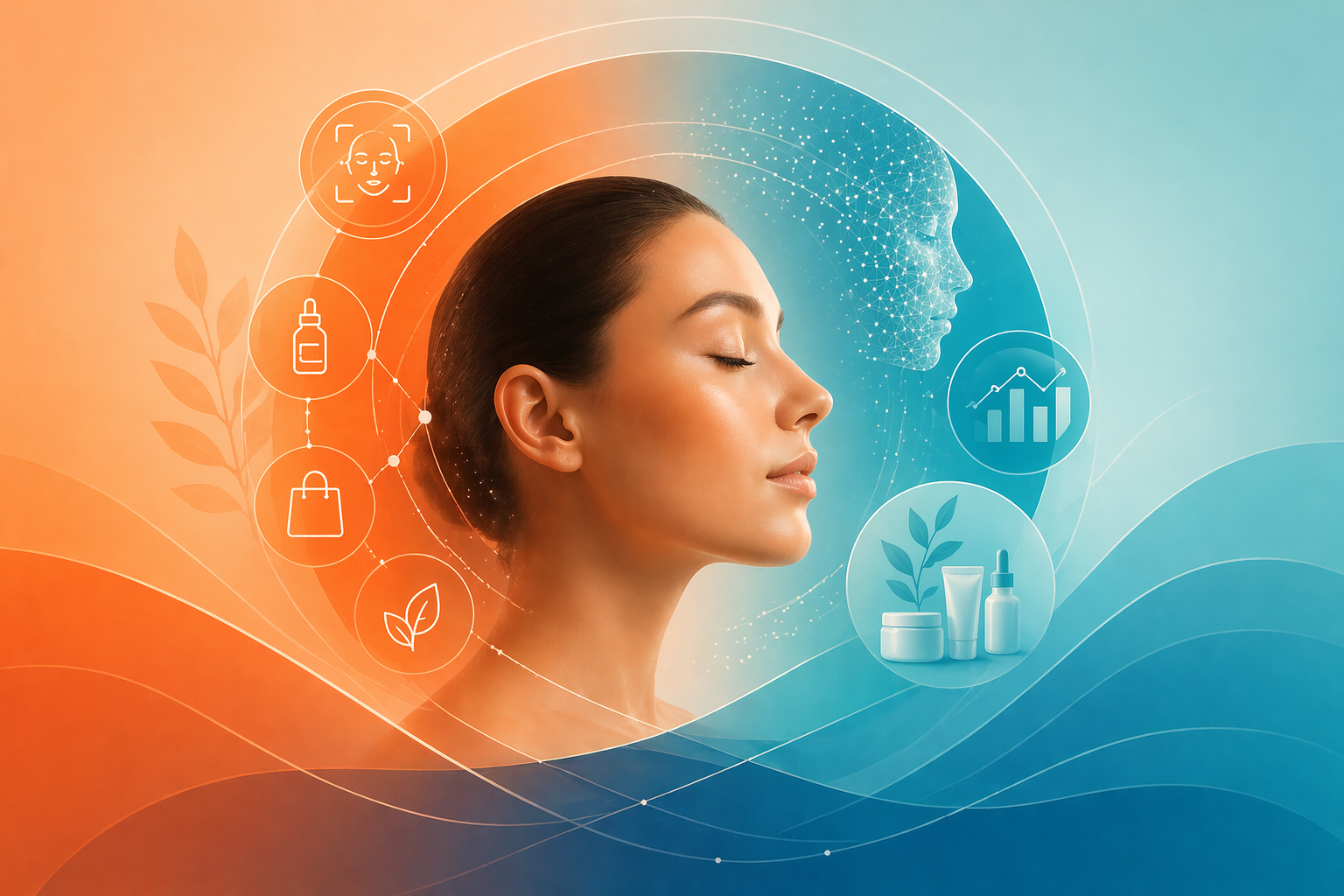

Transforming Digital Beauty Experiences
Transforming Digital Beauty Experiences
Transforming Digital Beauty Experiences

The beauty industry is entering a new era - and it’s not subtle.
After years of rapid innovation, endless product launches, and the rise of digital-first experiences, we’ve hit a critical inflection point. Consumers are no longer impressed by more. They’re overwhelmed by it.
What they want now is something very different: clarity, relevance, and results.
This shift is reshaping the entire industry - from how products are developed to how experiences are delivered. And at the center of it all are three forces: AI, data, and personalization.
From Choice Overload to Curated Simplicity
For years, the beauty industry has thrived in abundance. More products, more claims, more routines.
But that model is breaking down.
Today’s consumers - especially Gen Z and Millennials - are pushing back against complexity. Faced with thousands of options, they’re actively seeking simpler routines, fewer products, and clearer guidance.
This isn’t a rejection of innovation. It’s a rejection of noise.
What’s emerging instead is a new expectation:
- Fewer, more effective products
- Transparent, easy-to-understand benefits
- Guidance that removes friction from decision-making
In other words, curation is becoming more valuable than choice.
AI Is Becoming the Decision Layer of Beauty
This is where AI steps in - not as a gimmick, but as infrastructure.
The role of AI in beauty is shifting from experimentation to practical problem-solving. It’s helping consumers cut through complexity and make confident decisions.
We’re already seeing this in action:
- Skin diagnostics powered by computer vision
- Real-time recommendations based on environment and lifestyle
- Guided shopping experiences that adapt to individual needs
AI is no longer just about personalization - it’s about reducing cognitive load.
And the brands that win won’t be the ones with the most data, but the ones that use it to deliver clear, actionable outcomes.
Personalization Is Evolving Into Hyperpersonalization
Basic personalization is no longer enough.
The next phase is hyperpersonalization - where recommendations are:
- Continuous, not one-time
- Context-aware (environment, stress, lifestyle)
- Adaptive in real time
Advances in diagnostics, biosensors, and AI models are making this possible.
Skincare routines are starting to behave less like static prescriptions and more like living systems - evolving alongside the user.
This fundamentally changes the relationship between brands and consumers:
- From transactional → to ongoing
- From product-focused → to outcome-focused
- From generic → to deeply individual
Beauty Is Expanding Into Wellness and Longevity
At the same time, the definition of beauty itself is changing.
It’s no longer just about appearance. It’s about well-being.
Consumers increasingly see beauty as part of a broader system that includes:
- Sleep
- Stress
- Nutrition
- Hormonal balance
- Mental health
This is driving the rise of inside-out beauty - where skincare, supplements, and lifestyle are interconnected.
The implication is big:
Beauty is no longer a category. It’s becoming a wellness platform.
And with that shift, expectations are changing:
- Products must support long-term health, not just short-term results
- Experiences must feel personal, supportive, and holistic
- Brands must speak to identity, not just skin concerns
From Reactive to Predictive Beauty
Traditionally, beauty has been reactive.
You see a problem → you treat it.
That model is quickly becoming outdated.
With AI and real-time data, we’re moving toward predictive beauty:
- Identifying issues before they appear
- Adapting routines based on environmental changes
- Responding to stress, climate, and lifestyle in real time
This transforms skincare from maintenance into prevention and optimization.
The goal is no longer to fix problems - it’s to avoid them altogether.
Sustainability Is Now a Baseline Expectation
Alongside these shifts, sustainability has moved from a differentiator to a requirement.
Consumers are no longer satisfied with surface-level claims. They expect:
- Transparent sourcing
- Scalable, systemic solutions
- Products that align with their values without sacrificing performance
The conversation is evolving from “green products” to sustainable systems:
- Refillable and modular packaging
- Circular product lifecycles
- Data-driven ingredient sourcing
The challenge for brands is clear:
Sustainability must be seamless, scalable, and built into the experience - not added on.
The Real Challenge: Integration, Not Innovation
Here’s the uncomfortable truth:
The industry doesn’t lack technology.
It lacks integration.
Consumers don’t experience brands in channels - they experience them as a journey. And right now, that journey is often fragmented:
- Online vs in-store
- Discovery vs purchase
- Product vs experience
The next wave of innovation isn’t about adding more tools. It’s about connecting them into one continuous, intelligent system.
What Comes Next
The future of beauty will be defined by a few key principles:
- Simplicity over saturation
- Guidance over choice
- Systems over products
- Wellness over vanity
- Prediction over reaction
AI, data, and personalization are not trends - they are the foundation enabling this shift.
The brands that succeed will be the ones that:
- Remove friction instead of adding features
- Build trust through clarity and relevance
- Deliver experiences that feel intuitive, not overwhelming
A New Era of Beauty
We’re not just seeing incremental change.
We’re seeing a redefinition of what beauty is and how it works.
From isolated products to connected systems.
From surface-level fixes to whole-self support.
From mass experiences to deeply personal ones.
This is the turning point.
And what comes next will define the next decade of beauty.
Stay Tuned
We’ll be exploring these shifts - and what they mean for brands, retailers, and consumers - in much greater depth in our upcoming report.
If this is on your radar, stay tuned.


